


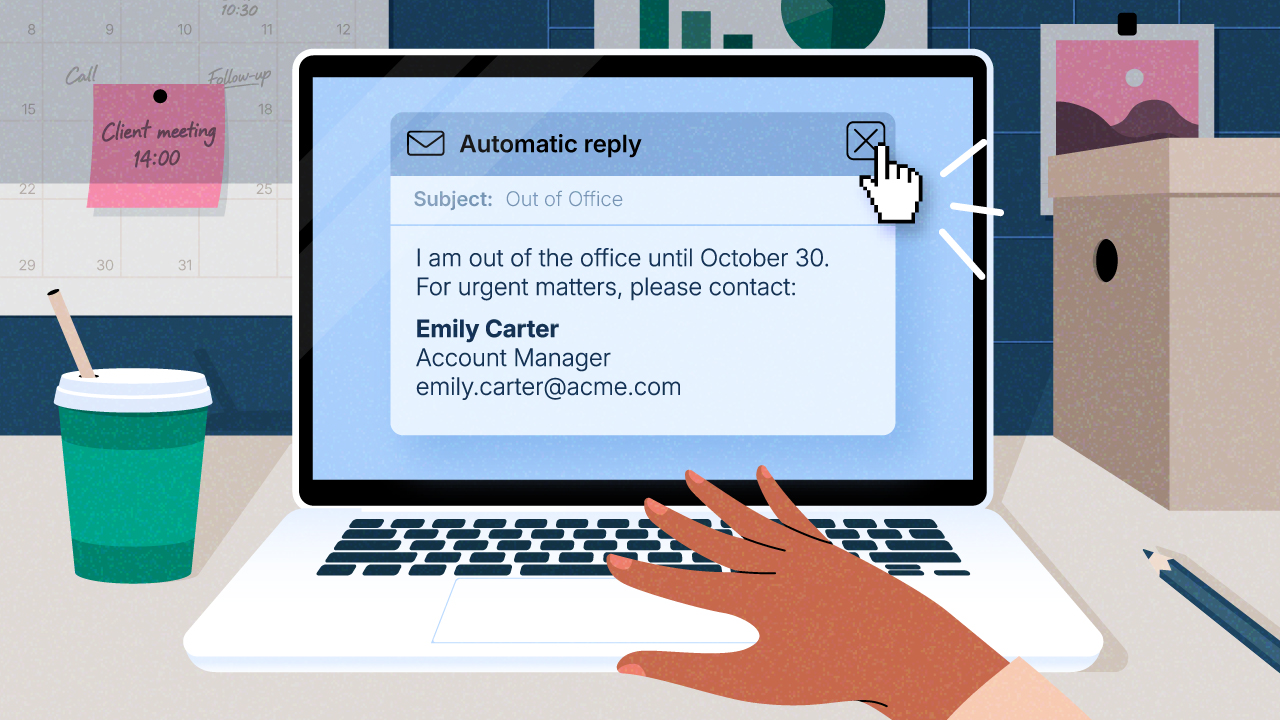
Among the many types of emails that pass through CRM systems, an out-of-office automatic reply is especially valuable — and especially easy to overlook. Such messages often include information about assistants, managers, or alternative contacts, including names, job titles, phone numbers, and email addresses. Yet these details can remain buried in email correspondence instead of becoming part of routine CRM data hygiene.
Although updating CRM contact data is important, for many people it is routine work that is easy to postpone. According to a study by Haas & Martarelli (2026, Humanities and Social Sciences Communications), such boring tasks rarely literally “slip from memory” — forgetting accounted for only 10–14% of uncompleted intentions in their study. Instead, tasks were often postponed repeatedly, with people choosing “later” until the right moment had passed. The potential result for CRM data quality is the same: important contact information never gets entered.
One limitation of conventional email-to-CRM workflows is that archiving an email does not necessarily mean interpreting its contents as a signal that CRM contact data needs to be updated. Email archiving integrations may associate a message with an existing contact based on a matching email address without identifying additional contact information contained in the message.
Meanwhile, when a sales rep receives an out-of-office reply, they may take one immediate action: set a reminder for a date after the person returns, so the follow-up does not get lost in the daily flow of tasks. But this is not a CRM contact update — it is a one-time action related to a single email. The next time another employee at the company writes to the same address, they may receive the same automatic reply, and the cycle repeats.
How often does this cycle repeat? Christmas holidays, vacation season, business trips, illnesses…
For a CRM administrator, this represents a specific, potentially measurable gap in CRM data hygiene: some contact records that could be valuable for customer interactions — and whose details have already been shared directly by the customer — may never be created or updated in the CRM system.
What Can Be Done Right Now, Without Additional Tools
First, conduct a sample review of the email archive from the past 6–12 months and estimate the share of out-of-office replies. Check how often these messages contain contact information that is missing from the CRM.
Second, check whether the company has a formal process defining who is responsible for updating CRM contact data when such an automatic reply arrives, and according to what rules. Where no clear process exists, these updates may depend entirely on the individual initiative of the sales rep.
Third, record this gap as a separate item in the CRM data hygiene improvement plan. Even a simple monthly sample review can help identify contact updates that might otherwise remain unnoticed.
Fourth, assess whether other types of messages contain similar signals, such as “I no longer work for the company,” “I have moved to a different role,” and so on.
Automating the extraction of contact information from emails is a natural next step when manual review becomes inefficient given the volume of a company’s email correspondence. But even without automation, systematically reviewing this category of messages can help improve CRM data completeness and accuracy.
Sources
- Haas & Martarelli (2026). “From delay to forgetting: how boredom and procrastination disrupt prospective memory.” Humanities and Social Sciences Communications. — https://www.nature.com/articles/s41599-026-07553-w