


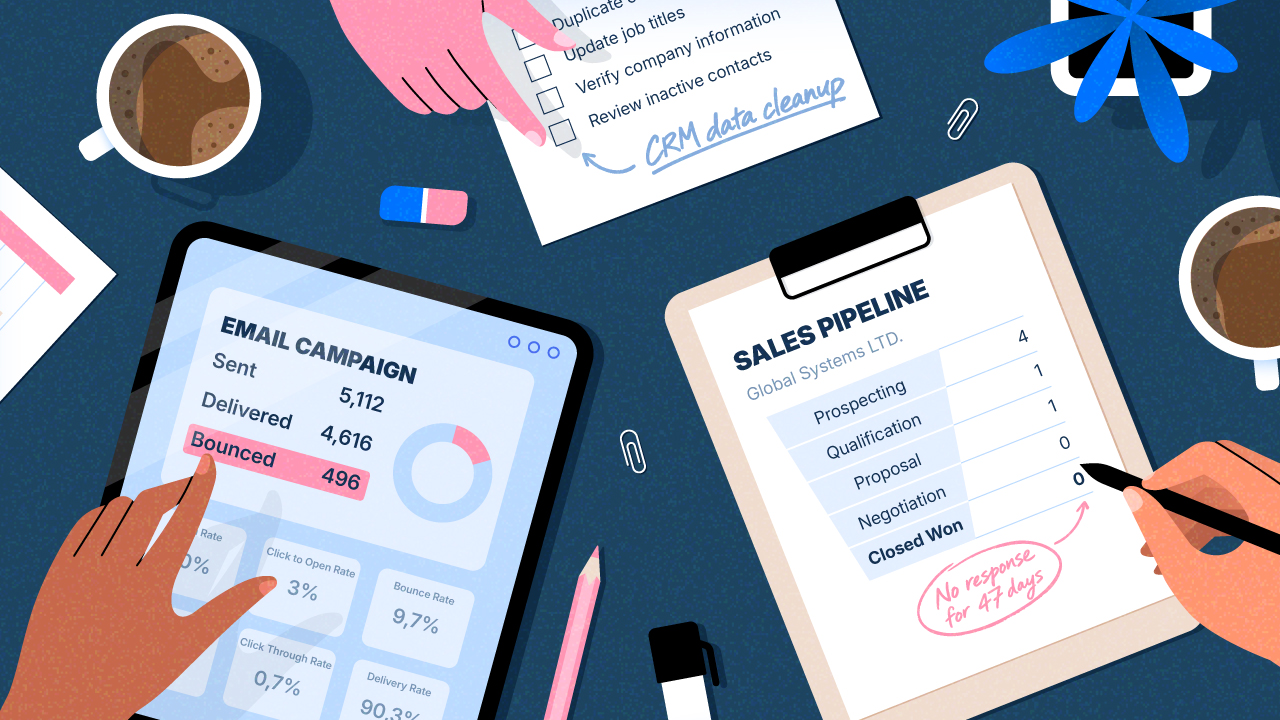
When we talk about “CRM data quality,” it can sound like a technical issue for someone in IT to worry about. In reality, poor CRM data quality has a business cost — and it affects at least four different roles across the company.
Let’s start with the numbers. According to a 2025 report by the IBM Institute for Business Value, 43% of Chief Operating Officers (COOs) identify data quality as their top data priority. A Forrester study cited by IBM found that more than 25% of organizations estimate their annual losses from poor data quality at over $5 million, while 7% put those losses at $25 million or more.
The impact is felt across different roles.
The sales department loses time and deals. According to a Gartner survey of 318 sales leaders conducted in August–September 2022, Sales Operations teams spent 73% of their time on activities outside direct sales support in 2022, nearly twice the 39% reported in 2019. Manually maintaining and verifying contact data is a typical example of this kind of “non-sales” workload that grows almost unnoticed.
Marketing works with the data it has: email segmentation and personalization rely on outdated job titles, companies, and contact details. Incomplete CRM data can mean targeting the wrong people or missing relevant audiences altogether.
For Compliance and Legal, incomplete or inaccurate customer data can create regulatory risk. It is not merely an operational inconvenience but also directly relates to compliance with the personal data accuracy principle established in Article 5(1)(d) of the GDPR — organizations are required to take “reasonable steps” to ensure that personal data is accurate and kept up to date.
For IT, maintaining CRM data accuracy can mean additional time and resources spent on data integration, verification, and cleansing rather than product development.
Another study provides a revealing result: the IDC white paper “Untapped Value: What Every Executive Needs to Know About Unstructured Data” (August 2023, commissioned by Box, based on a survey of 400 IT leaders) found that 90% of enterprise data is unstructured, while 41% of the companies surveyed acknowledge that less than half of such content is ever reused. Email correspondence is one example of a source where large volumes of unstructured business data can accumulate without being systematically reused.
We are not aware of a study that precisely measures what share of the multimillion-dollar losses mentioned above can be attributed specifically to email correspondence. The share is likely to vary from company to company depending on factors such as industry and sales cycle — so we present this connection as a logical inference, not as a separately verified figure.
The conclusion is simple: improving CRM data quality is not a task for any one department. It requires looking across the business — starting with a source of customer information that grows every day but is rarely analyzed systematically: the email archive.
Sources
- IBM (2025). “The True Cost of Poor Data Quality.” — https://www.ibm.com/think/insights/cost-of-poor-data-quality
- Gartner (2023). “Gartner Survey Finds Sales Operations Teams Dedicate Most of Their Time to Non-Sales Functions.” — https://www.gartner.com/en/newsroom/press-releases/2023-04-12-gartner-survey-finds-sales-operations-teams-dedicate-most-of-their-time-to-non-sales-functions
- IDC (2023), commissioned by Box. “Untapped Value: What Every Executive Needs to Know About Unstructured Data.” — https://blog.box.com/90-your-data-unstructured-and-its-full-untapped-value
- Regulation (EU) 2016/679 (GDPR), Article 5 — https://eur-lex.europa.eu/legal-content/EN/TXT/?uri=CELEX%3A32016R0679